
Angel Reese Questions Indiana’s 95–91 Win — Then Caitlin Clark Delivers an Ice-Cold Response
The Indiana Fever’s dramatic 95–91 victory over the Atlanta Dream already had everything required for a memorable WNBA night: pressure, momentum swings, physical basketball, emotional reactions and a finish that kept the tension alive until the closing moments.
But according to the viral storyline that erupted afterward, the final buzzer wasn’t the end of the drama.
What followed quickly shifted the conversation away from the scoreboard and toward an explosive war of words involving Angel Reese, the officiating, and ultimately Caitlin Clark — whose alleged 13-word response became the line everyone wanted to talk about.
Indiana Survives; Atlanta Frustrated
Indiana had survived the battle.
Atlanta had walked away frustrated.
And within minutes, a four-point game had transformed into something much bigger.
A 95–91 Battle That Left Emotions Boiling
From the opening possessions, there was little separation between the Fever and the Dream.
Atlanta refused to allow Indiana to settle comfortably into its rhythm, answering Fever runs with physical defense and aggressive basketball of its own. Every time Indiana appeared ready to create breathing room, Atlanta found another response.
The intensity only increased as the game moved deeper into the second half.
Possessions Become More Valuable
Possessions became more valuable.
Every whistle became magnified.
Every mistake suddenly carried consequences.
Indiana, however, found enough answers when the pressure was highest.
The Fever stayed composed through the chaos and eventually did what mattered most: they finished the night with a 95–91 victory.
For Indiana, it was the type of win that can strengthen confidence inside a locker room.
For Atlanta, it was the type of defeat that can leave players replaying crucial possessions long after they leave the arena.
And that frustration became the foundation for what happened next.
Angel Reese Allegedly Unloads After the Game
According to the dramatic account circulating around the matchup, Angel Reese was not interested in simply accepting the result and moving forward.
She allegedly believed there was another story behind Indiana’s victory.
And she reportedly made that frustration unmistakably clear.
“Let’s get something straight — Indiana didn’t earn that victory. They were handed it.”
It was a remarkable accusation.
But Reese reportedly wasn’t finished.
Instead of focusing solely on Atlanta’s mistakes or Indiana’s execution, she allegedly turned her attention toward the breaks that went Indiana’s way — particularly the officiating.
“You don’t beat a team like Atlanta with execution or discipline when the game unfolds like that — you beat them with breaks,” Reese reportedly said. “Indiana caught every break. They lucked into the momentum. They lucked into the biggest moments. And frankly, it looked like they got a little help from the officials when they needed it most.”
Suddenly, the discussion surrounding the game changed completely.
This was no longer simply about Indiana winning 95–91.
It was about whether the Fever deserved that victory at all.
Reese Takes the Accusation Even Further
Reese’s reported frustration centered on a question familiar to any team that loses a close game:
How can a team feel as though it controlled significant stretches of the contest and still leave with nothing?
According to the viral version of events, Reese put that frustration into words.
“Tell me how Atlanta — a team that controlled long stretches, fought for every possession and refused to back down — walks out of that arena with a 95–91 loss?”
Then came the sharper conclusion.
“The Dream played real basketball tonight. Indiana played with fortune on its side when everything was on the line.”
That alone would have been enough to generate debate.
But the most explosive allegation was still coming.
Reese reportedly took direct aim at the officiating:
“The officiating was embarrassing. The favoritism toward Indiana was impossible to hide — and the entire country saw exactly what happened.”
That was the line that changed everything.
WNBA Fans Immediately Take Sides
Once comments that strong enter the public conversation, there is rarely any middle ground.
Fever supporters would naturally see the criticism as an attempt to diminish a victory Indiana had fought hard to secure.
From their perspective, every close basketball game contains questionable whistles, missed opportunities and possessions that could have gone differently.
None of that changes the final score.
Atlanta supporters, meanwhile, could point toward the frustration of watching a close game slip away and argue that controversial calls deserve scrutiny, particularly when they occur during crucial moments.
And then there was the larger basketball audience — fans who immediately began examining individual possessions and debating whether Reese’s alleged criticism had merit.
Two completely different interpretations.
And an increasingly heated argument over who deserved credit — or blame — for the result.
But one voice was still missing.
Clark Refuses to Get Pulled Into the Noise
While the debate intensified, Clark reportedly remained quiet.
That silence only made the anticipation greater.
Would she defend her teammates?
Would she challenge Reese directly?
Would she respond to the officiating accusations?
Or would she refuse to engage?
According to the story, Clark eventually walked into the postgame media room knowing exactly what was waiting.
The 95–91 victory should have been the primary subject.
Instead, the questions surrounding Reese’s comments had become impossible to ignore.
Then someone finally asked Clark about them.
She simply leaned toward the microphone and delivered 13 words:
“You can blame every whistle you want — the scoreboard still says Indiana won.”
And just like that, the argument had its defining soundbite.
Why Clark’s 13 Words Hit So Hard
The power of the response wasn’t complicated.
Clark didn’t attempt to litigate every whistle.
She didn’t claim that the officials had been flawless.
She didn’t need to attack Reese personally.
Instead, she reduced everything to the one fact nobody could debate:
That is what made the alleged response so effective.
In professional sports, players rarely control how games are officiated. They control how they respond to adversity, how they execute possessions and whether they capitalize when opportunities appear.
The Fever did enough of those things to leave with the victory.
Clark’s message, at least in the version of the story spreading among fans, was essentially simple:
You can debate how Indiana got there.
You cannot debate where Indiana finished.
More Than Just Another Fever Victory
The most fascinating part of the controversy is that it potentially adds another emotional layer whenever these personalities and teams cross paths again.
WNBA games are rarely remembered only because of statistics.
They remember the moments when basketball begins feeling personal.
A 95–91 result can eventually become another number in a season full of them.
But accusations of favoritism?
A challenge to the legitimacy of a victory?
An ice-cold response from one of the biggest names in women’s basketball?
Those are the ingredients that keep a game alive long after the arena empties.
For Atlanta, the frustration would be understandable. Losing by four points means there are countless moments that can be replayed mentally — a missed shot, a turnover, a defensive breakdown, a questionable whistle.
For Indiana, however, the equation is much simpler.
The Scoreboard Gets the Final Word
There will always be arguments after close games.
Players can question decisions.
Analysts can replay possessions frame by frame.
Social media can spend hours deciding who was right and who was wrong.
But none of those debates can rewrite the official result.
Indiana Fever 95. Atlanta Dream 91.
And that is precisely why Clark’s alleged 13-word response became the perfect ending to such a combustible storyline:
And if this controversy carries into the next meeting between Indiana and Atlanta, those 13 words could ensure that the next opening tip feels like much more than the beginning of another basketball game.
New York Yankees Legend Don Mattingly Reacts To Heartbreaking News
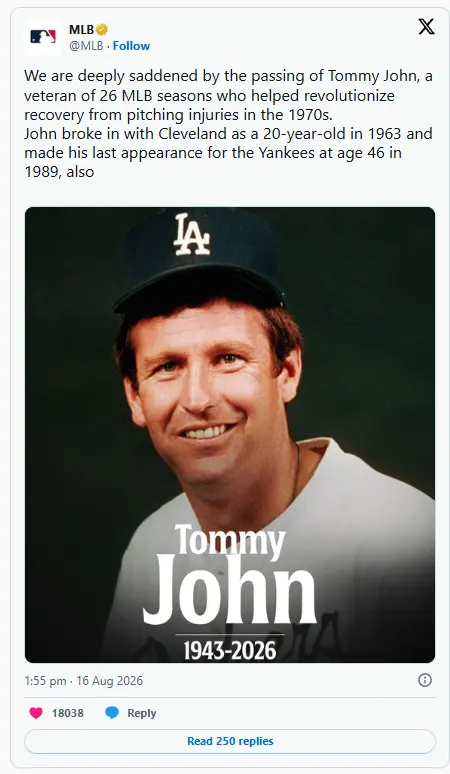
This week, the heartbreaking news that Tommy John had passed away was announced.
Via MLB: “We are deeply saddened by the passing of Tommy John, a veteran of 26 MLB seasons who helped revolutionize recovery from pitching injuries in the 1970s.”
Yankees Legend Don Mattingly Reacts
Interim manager Don Mattingly looks on prior to a game against the Minnesota Twins at Field of Dreams on August 13, 2026 in Dyersville, Iowa.
One person to react to the news was his former Yankees teammate Don Mattingly.
Mattingly (via The Yankees): “I am deeply saddened to learn of the passing of my friend, Tommy John. Tommy and I were both from Indiana and shared a Midwest bond while playing in New York together. He was a great pitcher and the ultimate competitor. I offer my sincere condolences to his family, friends and all those who loved him.”
Tommy John #25 of the New York Yankees poses for a portrait during the 1988 season.
Here’s what other teams around the baseball world were saying:
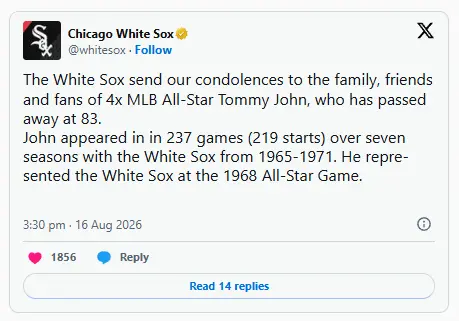
Chicago White Sox: “The White Sox send our condolences to the family, friends and fans of 4x MLB All-Star Tommy John, who has passed away at 83. John appeared in in 237 games (219 starts) over seven seasons with the White Sox from 1965-1971. He represented the White Sox at the 1968 All-Star Game.”
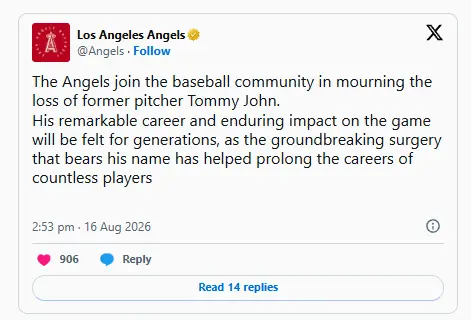
Los Angeles Angels: “The Angels join the baseball community in mourning the loss of former pitcher Tommy John. His remarkable career and enduring impact on the game will be felt for generations, as the groundbreaking surgery that bears his name has helped prolong the careers of countless players throughout baseball. Acquired by the Angels in 1982, John helped bolster the Club’s starting rotation during their race to an AL West division title. He would go on to appear in parts of four seasons with the Angels (1982-85) and paced the Angels staff in innings pitched and tied for the team lead in wins in 1983. We extend our heartfelt condolences to Tommy’s family, friends, and teammates.”
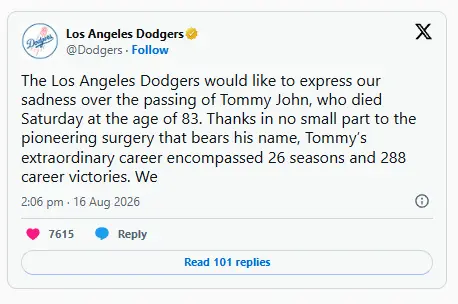
Los Angeles Dodgers: “The Los Angeles Dodgers would like to express our sadness over the passing of Tommy John, who died Saturday at the age of 83. Thanks in no small part to the pioneering surgery that bears his name, Tommy’s extraordinary career encompassed 26 seasons and 288 career victories. We offer our deepest condolences to his family and friends.”
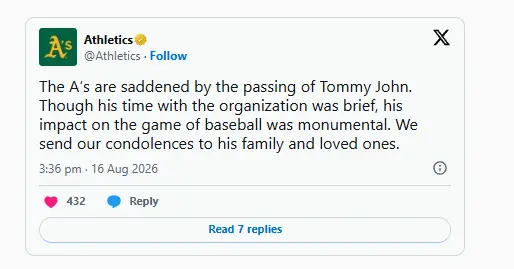
Athletics: “The A’s are saddened by the passing of Tommy John. Though his time with the organization was brief, his impact on the game of baseball was monumental. We send our condolences to his family and loved ones.”
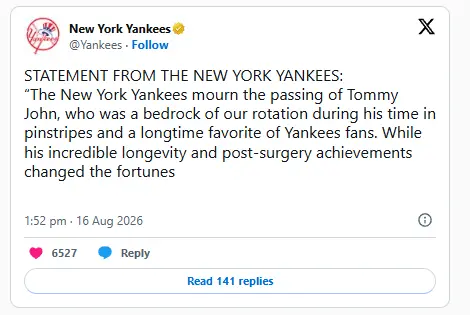
New York Yankees: “The New York Yankees mourn the passing of Tommy John, who was a bedrock of our rotation during his time in pinstripes and a longtime favorite of Yankees fans. While his incredible longevity and post-surgery achievements changed the fortunes and trajectory of countless athletes around the world, it also overshadowed his excellence as a pitcher, which included consecutive 20‑win seasons with the Yankees. We pause to remember the totality of his legacy — his competitiveness and skill, his penchant for conversation, his kind and gracious nature, and his stature as an athletic and medical pioneer. The Yankees extend our deepest condolences to his family and friends, including wife, Cheryl, daughter, Tamara, and sons Tommy III and Travis. We also keep his son Taylor in our hearts.”